Yacht Class n°45 (june-july-august2026)
A schooner of the French Navy, Étoile, called at the Principality and received
a visit from H.S.H. Albert II, Prince of Monaco.
Written by : Christophe Varène – Photos : Yacht Club de Monaco
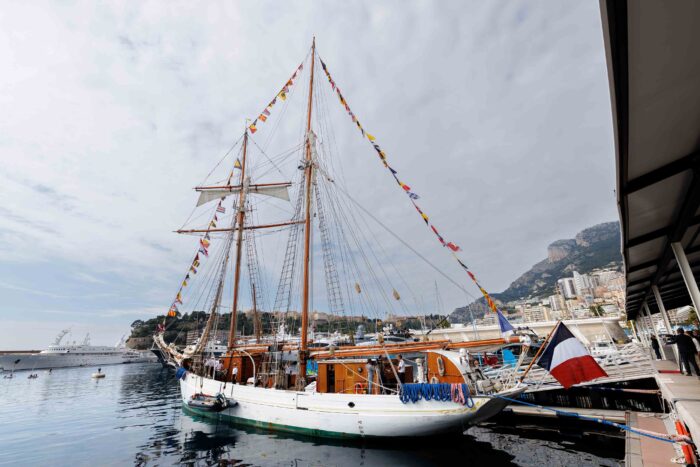
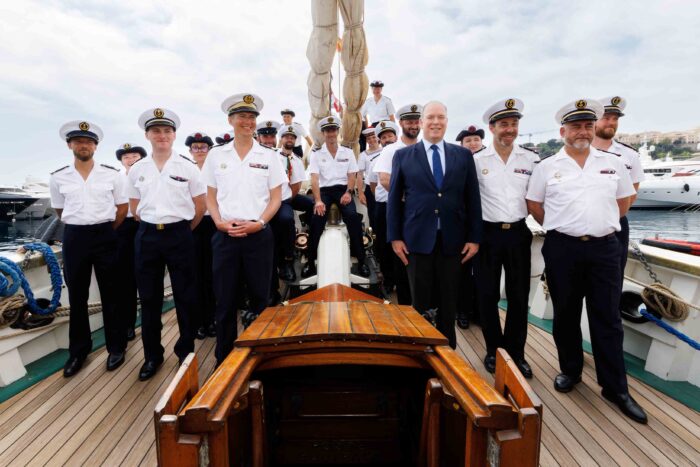
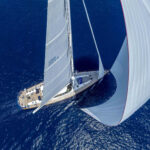
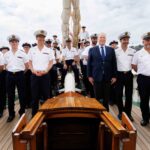
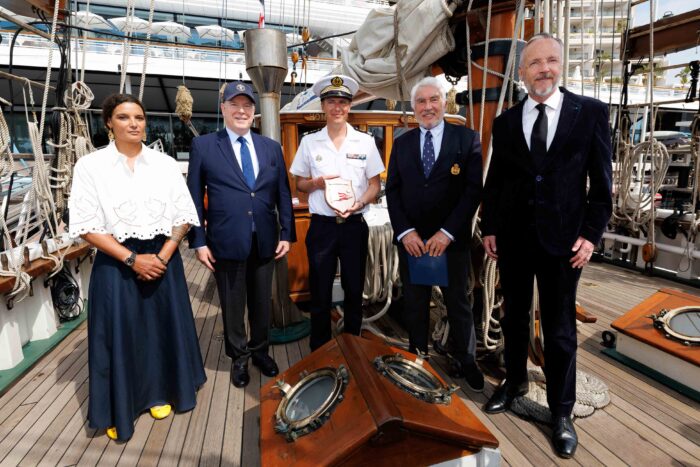
On 28th April, a remarkable vessel—distinguished alike by her imposing dimensions, her venerable age, and her uniformed crew—paid a brief visit to Monaco’s Port Hercules, berthing before the Yacht Club de Monaco. This proud schooner, named Étoile, is one of the sail-training ships of the French Navy, which this year celebrates the four-hundredth anniversary of its founding. Her call at the Principality also attests to the strong bonds of cooperation between France and Monaco. On this occasion, the Prince himself came to greet Lieutenant Victor Kaars Sijpeesteijn, commanding officer of the vessel and her company of officer cadets, presenting him with a ceremonial nameboard bearing the Yacht Club de Monaco’s insignia together with the club’s coat of arms. The ceremony took place in the presence of H.E. Mr Jean d’Haussonville, Ambassador of France to Monaco; Mr Bernard d’Alessandri, Secretary and Director General of the YCM; and Ms Marie Tabarly, navigator and daughter of Éric Tabarly, himself a former officer of the French Navy.
Employed as a training vessel for naval officer cadets, the schooner Étoile forms part of a flotilla that includes her sister ship Belle Poule, as well as the Mutin (a dundee built in 1926 at the Florimond-Guignardeau yard in Les Sables-d’Olonne, modelled on traditional sailing tuna boats), the Grande Hermine (a gaff-rigged yawl constructed in 1931 at the Fidèle yard in Marseille), and the Feu Follet (a pilot cutter built in 1987 at the Pemple yard in Rochester, Great Britain). Étoile herself is a topsail schooner, built at Fécamp in 1932 by the Chantiers navals de Normandie, to plans drawn up by the naval architects Chantelot and Lemaistre, inspired by the Paimpol schooners that once sailed to Iceland for the cod fisheries. Alongside Belle Poule, she served during the Second World War with the Free French Naval Forces, an honour that entitles both vessels to fly, from their bowsprit, the French tricolour bearing the Cross of Lorraine. She is capable of embarking between fifteen and twenty-five cadets from the Naval Academy at Lanvéoc-Poulmic, in the roadstead of Brest. Measuring 37.5 metres overall, with a beam of 7.4 metres, she carries 450 square metres of sail and has a light displacement of 225 tonnes. For spectators of all ages, whether at great gatherings of tall ships such as L’Armada in Rouen or the Brest Maritime Festival, or during stopovers such as this one in the Principality, the sight of these vessels of another age, and of their crews in full dress uniform, remains deeply stirring… leaving stars in the eyes of all who behold them.