Yacht Class n°44 (March-April-May 2026)
The Yacht Club de Monaco brought together the sector’s elite to anticipate the transformations of a €54-billion industry facing the imperatives of sustainability.
Written by : Anaïs Riu – Photos : YCM / Direction de la Communication – Stéphane Danna
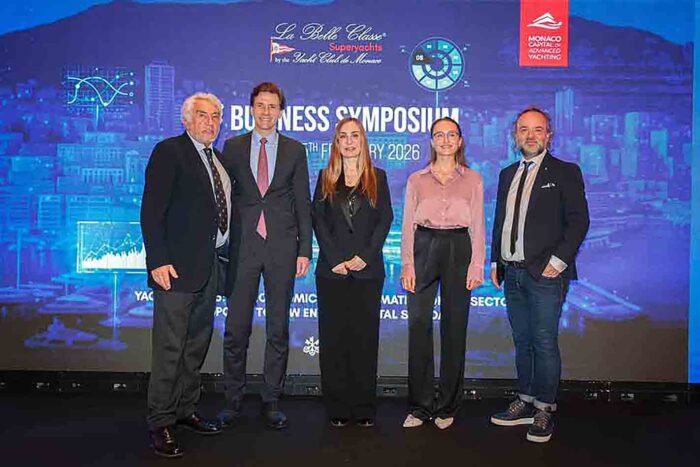
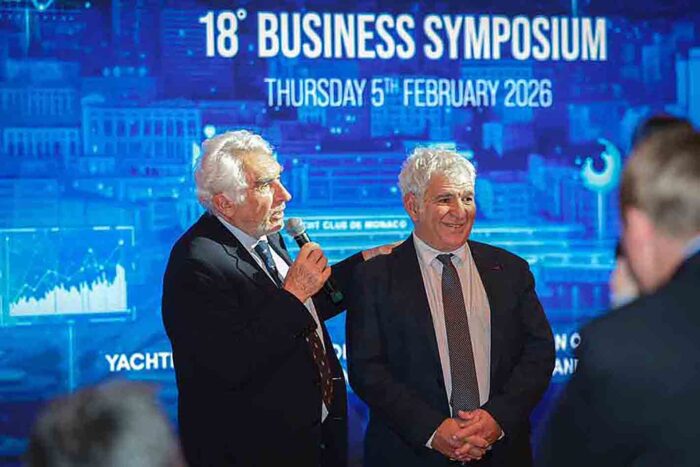
The hushed wood-panelled rooms of the Yacht Club de Monaco still echo with the lively exchanges of its 18th Economic Symposium – La Belle Classe Superyachts. On Thursday 5th February, nearly a hundred leading figures from the international yachting world gathered for a dinner-debate organised in collaboration with UBS, all driven by the same question: how can environmental constraints be turned into economic opportunities? Blending macroeconomic analysis with avant-garde projects, the evening sketched the outlines of a reimagined yachting industry aligned with the strategic initiative “Monaco, Capital of Advanced Yachting.”
A robust market undergoing major reshaping
With 6,200 superyachts over 30 metres currently in operation, the industry is displaying strong health. Francesca Webster, Editor-in-Chief of SuperYacht Times, tempers this positive picture: “By the end of the year, transaction volumes had surpassed 2024 levels, with total sales and overall gross tonnage significantly higher than in previous years,” following a hesitant first half marked by geopolitical uncertainty. Beyond sheer volume, it is the very nature of the market that is evolving: longer decision-making cycles, more complex projects, and the integration of environmental criteria from the design stage onward. “We are seeing a growing awareness among owners. Vessel sustainability is becoming a key factor,” she notes. The market is shifting toward large-scale projects, particularly in the segment above 80 metres, while refit activities continue to confirm their strategic importance, generating an economic impact of €5.6 billion. “Seventy-one percent of this amount comes from indirect activities,” Webster specifies, highlighting the ripple effect on local economies.
The “5Ds” redefine the economic horizon
Maximilian Kunkel, Chief Investment Officer at UBS, frames his forward-looking analysis around five major dynamics: demography, deglobalisation, decarbonisation, digitalisation, and debt. “The way we work, where we work, our professional activities, and our consumption patterns – everything is changing,” he explains. Taken together, these forces generate both tensions and opportunities, where productivity gains can help offset constraints on growth.
Innovation born of constraint
The 2035 horizon is now shaping today’s strategic decisions. Dr. Nathalie Hilmi delivers a clear message: “Environmental regulation is no longer a future concern. It has become a structural economic driver. Emissions are no longer an external cost – they are turning into a financial liability that directly impacts operating margins.” In an industry where new-build construction represents €20 billion, adapting to regulatory standards has become a strategic imperative. Txema Rubio of the MB92 Group confirms this shift: “By 2035, yachting will be shaped as much by how we modernise the existing fleet as by what we build next.” Marnix Hoekstra of Vripack illustrates this transformation with Project Zero, a zero-emissions monohull combining thermal, solar, and wind energy. “I believe sustainability is the greatest design challenge of our generation,” he states, before outlining this visionary project in which “everything that requires heat comes from our thermal system, and everything that needs electricity comes from our battery.”
Strength in unity
Bernard d’Alessandri, Managing Director of the Yacht Club de Monaco, recalled the spirit driving this initiative: “Yachting is part of an economic, environmental, and human ecosystem that calls for a collective, long-term vision. This symposium provides a unique platform where all stakeholders across the value chain can come together, exchange ideas, and move the industry forward collectively.” This message was echoed by Christophe Madrolle, Regional Councillor for Provence–Alpes–Côte d’Azur: “All these regulations allow us to build a new strategy. Alone, we go faster; together, we go further.” This momentum will continue at the Monaco, Capital of Advanced Yachting Rendezvous (21st – 24th March), which will feature a careers fair aimed at younger generations. Because at its core, this is about the future – and about passing the torch