Presentation
Yacht Class n°43 (Dec-Jan-Feb 2026)
CNB – Solaris
The development of the CNB 62 continues to be marked by the offshore sailing criteria that are so important to the brand, with the transition to the Solaris group’s flagship enabling further improvements in build quality and finish. Seasoned shipowners will feel at ease embarking on long-distance voyages.
Written : Christophe Varène – Photos : DR
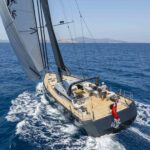
Past the dizzying period of autumn boat shows and the discovery of new units, it is time to head back out to sea and confirm the impressions – often favourable – left by some of them. So when the opportunity arises to take the brand new CNB 62 out for a spin, it would be impossible, not to mention unprofessional, to refuse. The date was set for October at Cap d’Agde, at Sud Croisière Yachts, the reference centre for sailboats built at CNB. Several boats of the brand are moored at the pontoons or in dry dock, awaiting winter maintenance or minor refits. Among them, the CNB 62, successor to the famous Bordeaux 60, catches the eye: the second model unveiled after the 78 and the takeover of the brand by the Italian group Solaris, she benefits from the same “French touch”, in this case that of Philippe Briand for the architecture and exterior design, combined with the style of Jean-Marc Piaton for the interiors.
Long voyages with a small crew
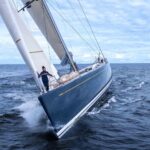
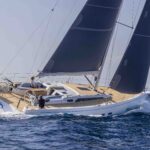
The CNB 62’s primarily offshore vocation explains her sleek yet voluminous lines, her distinctive protective deckhouse and her arch to free the cockpit from the mainsail sheet. Similarly, the principle of uninterrupted teak slats – using the scarves method (the ends of the slats are cut at an angle for an invisible connection) – on the deck, like other details, emphasises the increasingly high-end finishes. Access on board via the integrated gangway on the port side provides an opportunity to discover the transom and its opening: this is electrically controlled and a flight of steps automatically unfolds to descend onto the platform, either for swimming or to take out the dinghy stored lengthwise. The cockpit has a fairly classic layout for a sailing boat designed for long voyages with a small crew – because this is an essential feature of the CNB 62’s design: to be a true owner’s boat. With this in mind, the large sprayhood and its extended sides immediately convey a feeling of safety, as do the forward, centrally located helm stations and the powerful electric winches located at the rear in an area dedicated to manoeuvring.
No need to go to the foot of the mast
All these aspects come into play as soon as you cast off. The skipper can sit on either the port or starboard side, as both consoles have all the engine controls and most of the adjustment buttons. The presence of two rudders justifies the bow and stern thrusters for manoeuvrability. The position of the winches allows the helmsman to use them without having to move in front of the console. Leaving the port of Cap d’Agde is therefore easy, but the light breeze means we have to head out to sea to find some wind, which is a good way to test the performance of the engine: at 2,200 rpm, the hull glides along at 8 knots, without vibration and in real acoustic comfort. As soon as the sea surface begins to ripple, it is time to switch to sailing mode. There is no need to go to the foot of the mast to set the sails: by tapping the buttons on the console, the furling mast allows the mainsail to be easily deployed and the genoa unfurls in the process. Light winds do not allow you to appreciate the speed potential, but with 5.5 knots of wind, the CNB 62 displays a nice 5 knots at 50 degrees to the true wind. The helm is smooth with surprising responsiveness. All you have to do is raise it a little more to create more apparent wind and accelerate. This ability makes it possible to cut the engine very quickly.
An asymmetrical layout
When tacking under genoa, everything is controlled from the helm stations: furl the genoa, thanks to the self-tacking staysail, tack and unfurl it on the other side. As for the mainsail, there is no need to worry: with the sheet attached to the carbon bow (a custom-made 80 kg piece), there is no risk to passengers in the cockpit. They can enjoy the saloon reserved for them, with a long bench seat on the starboard side and, opposite, a U-shaped bench seat surrounding a table that can be converted into a sunbathing area. Conveniently, the passage to the interior is offset to starboard, allowing the table to be set without obstructing traffic. This slight asymmetry also brings solutions in interior fittings, which must now be discovered. The companionway has wide steps curved at the edges and two vertical handrails for ease and safety of use. Light is not a meaningless word when you consider all the openings in the saloon. The raised floor above the engine compartment also ensures perfect visibility of the surroundings. This central area of the CNB 62 is divided into different zones: a lounge with a table for six or eight people on the port side, a relaxation area with two facing benches and a coffee table on the starboard side, one of the two backrests folding down to free up a seat for the chart table. A clever way to optimise space. The galley occupies the entire width of the forward section, combining space and ergonomics.
For long-distance sailing
The owner’s cabin is located towards the bow, with a double bed against the forward bulkhead and accessible on three sides. The asymmetrical design allows for a large bathroom on the port side and generous storage space on the starboard side. A small skipper’s cabin can take the place of the sail locker in the bow, but the whole philosophy of the CNB 62 is based on use by the owner, without a permanent crew. At the rear, accessed by a small passageway that creates privacy from the saloon, two guest cabins (double bed or twin beds that can be joined together) are the same size, with one of the two bathrooms slightly larger than the other, due to the asymmetry. This new model has all the features that have made the brand so successful: designed for use by a couple of owners, comfortable for long-distance cruising, refined fittings, and increasingly high-end features and finishes.
Technical sheet